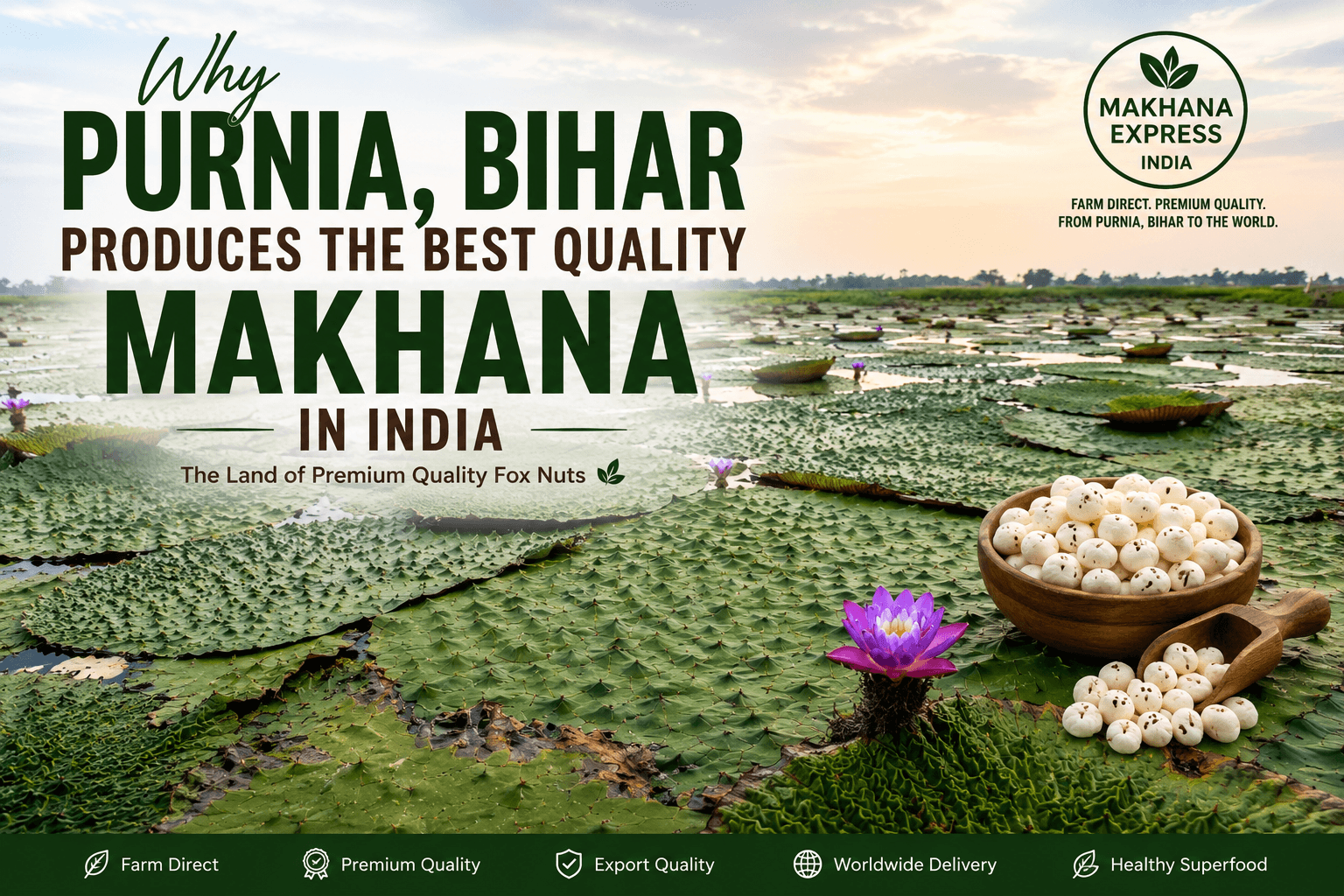
Why Purnia Bihar Produces the Best Quality Makhana in India
Introduction — India's Makhana Capital
There are thousands of food products grown across India. But very few are as deeply connected to a single region as makhana is to Purnia, Bihar.
Walk into any premium dry fruit store in Delhi, Mumbai, or Bangalore. Pick up a pack of the finest, whitest, crunchiest makhana you can find. Turn it over and read the origin — nine times out of ten, it traces back to Bihar.
And within Bihar, one district stands above all others: Purnia.
This isn't marketing. It's geography, science, and centuries of inherited agricultural wisdom working together to produce a superfood that no other region in the world has been able to replicate at the same quality level.
India produces approximately 90% of the world's makhana (fox nuts / lotus seeds). And within India, Bihar alone accounts for over 80% of total production — with Purnia, Katihar, Madhepura, Kishanganj, and surrounding districts forming the heart of this ancient industry.
But raw numbers only tell half the story.
The real question isn't just how much makhana Bihar produces. The real question is: why is the quality so remarkably superior?
In this comprehensive guide, we'll explore the science, geography, farming traditions, and quality systems that make Purnia makhana the gold standard of the global fox nuts market.
Whether you're a wholesaler sourcing premium raw makhana, an exporter looking for export quality fox nuts, or simply curious about this remarkable healthy superfood — this article will give you the deepest understanding available anywhere on the internet.
Let's begin.
🌿 What is Makhana?
Before we dive into why Purnia produces the best, let's establish what makhana actually is.
Makhana (scientific name: Euryale ferox) is an aquatic plant that grows naturally in stagnant water bodies — ponds, lakes, and wetlands across the Indian subcontinent and parts of East Asia.
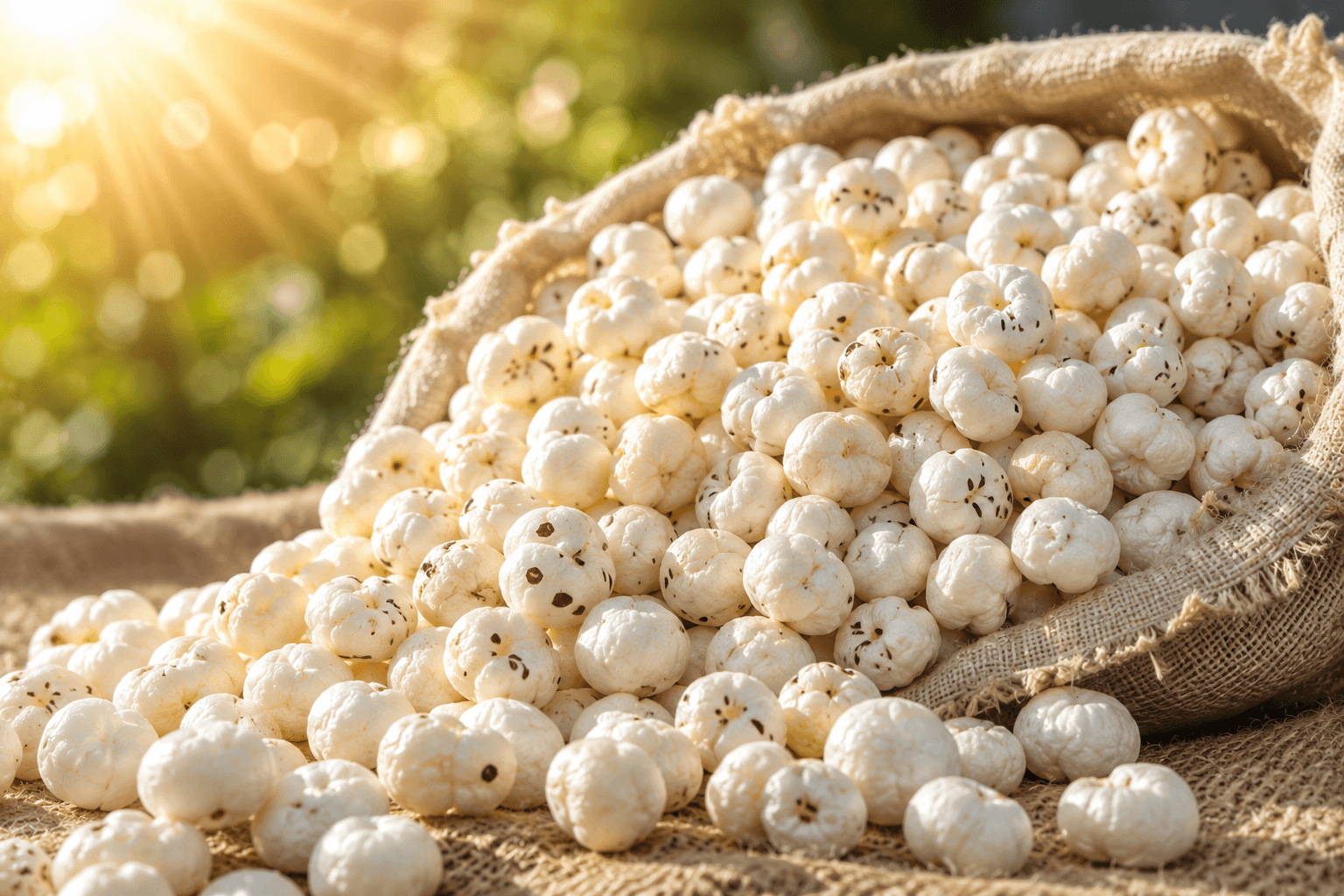
The edible part is the seed, which is harvested from the plant's fruit, dried, and then roasted at high heat until it pops — similar to popcorn. These popped seeds are what we know as makhana, fox nuts, phool makhana, or lotus seeds.
Quick Facts:
| Attribute | Detail |
|---|---|
| Scientific Name | Euryale ferox Salisb. |
| Common Names | Makhana, Fox Nuts, Lotus Seeds, Phool Makhana, Gorgon Nut |
| Plant Type | Aquatic, annual |
| Growing Medium | Stagnant freshwater ponds and wetlands |
| Primary Growing Region | Bihar, India (especially Purnia, Katihar, Madhepura) |
| Harvest Season | September–December (major), June–July (minor) |
| Global Market Share | India produces 90%+ of world supply |
| Nutritional Category | High protein, gluten-free, low-fat superfood |
🏆 Why Purnia, Bihar is the Makhana Capital of India
The superiority of Purnia makhana isn't an accident. It's the result of five natural advantages that this region possesses — advantages that cannot be artificially replicated anywhere else.
3.1 🌤️ The Perfect Climate
Makhana requires a very specific climate to thrive — and Purnia delivers it perfectly.
Purnia's Climate Profile:
| Climate Factor | Purnia, Bihar | Ideal for Makhana |
|---|---|---|
| Annual Rainfall | 1,300–1,600 mm | ✅ Perfect |
| Average Temperature | 25–35°C (Summer) | ✅ Ideal |
| Humidity | 70–85% | ✅ Optimal |
| Monsoon Duration | June–September | ✅ Critical growth period |
| Winter Temperature | 8–15°C | ✅ Perfect for drying |
| Frost Risk | Very Low | ✅ Safe for plants |
Why this matters:
Makhana plants need long, warm, humid summers for seed development and dry, mild winters for harvesting and sun-drying. Purnia's tropical monsoon climate provides exactly this annual cycle — year after year, with remarkable consistency.
Regions with irregular rainfall or extreme winters (like parts of Rajasthan, Madhya Pradesh, or UP) simply cannot provide the sustained warm humidity that makhana requires during its critical 4-month growth phase.
3.2 🌱 Mineral-Rich Alluvial Soil
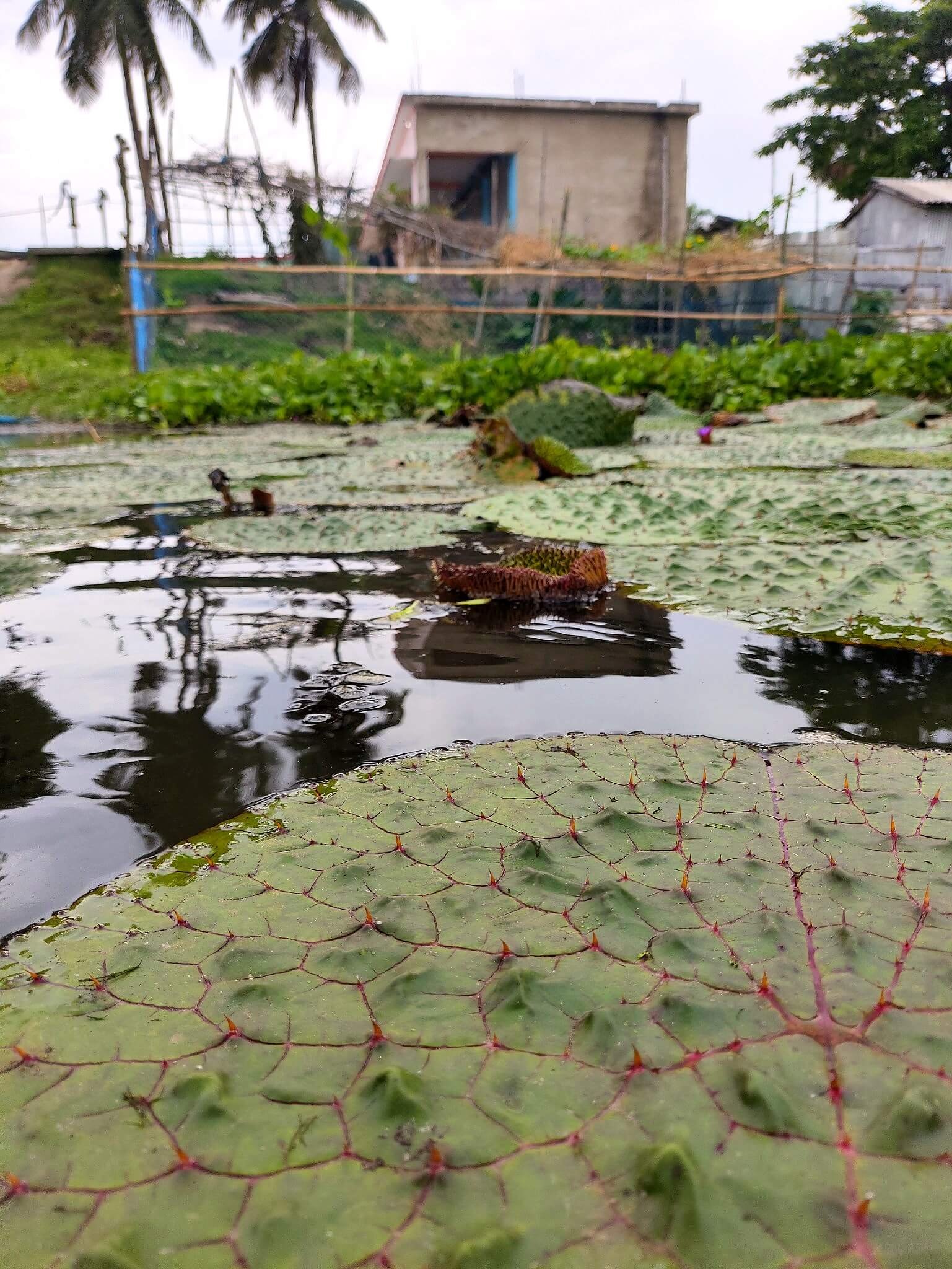
The soil beneath Purnia's ponds is what truly sets it apart.
Purnia sits on the Indo-Gangetic alluvial plain, enriched over millions of years by sediment deposits from the Kosi River (often called the "Sorrow of Bihar" for its flooding — but this flooding is actually what makes the soil incredibly fertile).
Purnia's Soil Composition:
| Mineral | Level in Purnia Soil | Impact on Makhana |
|---|---|---|
| Nitrogen | High | Promotes plant growth |
| Phosphorus | Moderate-High | Strengthens seed development |
| Potassium | High | Enhances taste and texture |
| Organic Carbon | Very High | Feeds pond microorganisms |
| Iron | Moderate | Supports plant nutrition |
| Calcium | Moderate | Contributes to makhana's calcium content |
| pH Level | 6.0–7.5 (Neutral) | Ideal for Euryale ferox |
The result?
Makhana seeds grown in Purnia's mineral-rich alluvial soil are:
- ⚪ Whiter (purer calcium content)
- 💪 Larger (better nutrient absorption)
- 🌾 Crunchier (optimal starch composition)
- 😋 Tastier (richer mineral profile)
No other region in India has this exact combination of alluvial richness combined with the right pH balance for makhana cultivation.
3.3 💧 Abundant Natural Lotus Ponds
Makhana doesn't grow in regular farm fields. It grows exclusively in shallow, stagnant freshwater ponds — and Purnia has thousands of them.
Purnia's Pond Ecosystem:
- 🏞️ Over 10,000+ natural and man-made ponds across the district
- 💧 Average pond depth: 2-5 feet (ideal for Euryale ferox)
- 🌸 Natural lotus vegetation provides organic shade and nutrients
- 🐟 Fish and aquatic organisms create a balanced ecosystem
- 🌿 Minimal pollution — ponds are in rural, unpolluted areas
These ponds have been used for makhana cultivation for generations — some for over 200 years. The organic matter that has accumulated over decades creates a self-sustaining ecosystem that commercial pond construction simply cannot replicate.
3.4 🌊 Unique Water Ecosystem
The water in Purnia's makhana ponds isn't just ordinary water. It's a mineral-rich, slightly acidic, organic ecosystem that provides everything the makhana plant needs.
Water Quality Factors:
| Factor | Purnia Ponds | Why It Matters |
|---|---|---|
| pH Level | 6.5–7.2 | Optimal for seed formation |
| Dissolved Oxygen | Moderate | Supports plant metabolism |
| Organic Matter | High | Natural fertilizer |
| Temperature | 25–30°C | Ideal for growth |
| Depth | 2–5 feet | Perfect for root anchoring |
| Flow | Stagnant/Slow | Prevents seed displacement |
The Kosi River basin's groundwater feeds many of these ponds, bringing fresh minerals while maintaining the stagnant conditions that makhana requires.
3.5 👨🌾 Generations of Farming Expertise
Perhaps the most underappreciated factor is the human element.
Makhana farming is extremely labor-intensive and skill-dependent. It cannot be mechanized. Every step — from seed planting to harvesting to roasting — requires specialized knowledge passed down through generations of farming families.
In Purnia, this knowledge chain goes back centuries. Families in villages like Bhawanipur, Kasba, Amour, and Baisi have been cultivating makhana for 8-10 generations.
What these farmers know that others don't:
- 🌱 Exactly when to plant seeds based on water temperature
- 🌸 How to read lotus leaf patterns to predict yield quality
- 🤿 Underwater harvesting techniques (diving 3-5 feet in muddy water)
- 🔥 The precise roasting temperature and duration for each grade
- 👁️ Visual grading — sorting by size, color, and texture in seconds
- 📦 Optimal drying time based on humidity and season
This institutional knowledge is irreplaceable. It's why makhana grown in other states — even with similar climate conditions — never matches the consistency and premium quality of Purnia makhana.
📊 How Purnia Makhana Compares to Other Regions
Several other states in India have attempted makhana cultivation, but the results consistently show Purnia's superiority.
Regional Comparison:
| Parameter | Purnia, Bihar | West Bengal | Assam | Madhya Pradesh | Rajasthan |
|---|---|---|---|---|---|
| Annual Production | 80,000+ MT | 5,000 MT | 2,000 MT | 1,000 MT | 500 MT |
| Average Seed Size | Large (5-6+ Suta) | Medium (3-4 Suta) | Small-Medium | Small | Very Small |
| Color | Bright White | Off-White | Yellowish | Cream | Yellow |
| Taste | Rich, Sweet | Mild | Flat | Bland | Bland |
| Crunch After Roasting | Excellent | Good | Average | Poor | Poor |
| Expansion Ratio | 30-40% | 20-25% | 15-20% | 10-15% | 10% |
| Shelf Life | 12-18 months | 8-10 months | 6-8 months | 4-6 months | 4-6 months |
| Export Quality Available | ✅ Yes | Limited | ❌ No | ❌ No | ❌ No |
| Traditional Expertise | Centuries | Decades | Recent | Very Recent | Experimental |
Verdict: No other region comes close to matching Purnia's combination of volume, quality, size, and consistency. This is why premium makhana buyers worldwide source exclusively from the Purnia-Kosi belt of Bihar.
🌾 The Makhana Farming Process in Purnia
Understanding how makhana is farmed helps explain why the final product is so special.
Annual Farming Calendar:
| Month | Activity | Details |
|---|---|---|
| January-Februry | Pond Preparation | Cleaning, water level management |
| February-March | Seed Sowing | Seeds planted in pond beds |
| March-April | Growth Phase | Monsoon rains fuel rapid growth |
| April-May | Flowering | Beautiful purple lotus flowers bloom |
| May-June | Fruit Formation | Seeds develop inside thorny fruits |
| June-September | Harvesting | Divers collect seeds from pond bottom |
| September-December |
Sun Drying & Processing |
Seeds dried naturally for 5-7 days & Roasting, popping, and grading |
The Harvesting Challenge:
This is where Purnia's farmers demonstrate extraordinary skill and endurance.
Makhana harvesting requires:
- 🤿 Diving into murky, cold pond water (3-5 feet deep)
- 👣 Walking barefoot on muddy pond floors
- 🦶 Feeling for seeds buried 6-12 inches in mud
- ⏰ 6-8 hours daily in water
- 💪 Carrying 20-30 kg loads of wet seeds
- 🌡️ Working in cold October-November temperatures
No machine can do this. It requires human skill, endurance, and generational knowledge.
This is exactly why authentic Purnia makhana commands a premium — because every single seed is literally hand-harvested from the bottom of a pond by skilled farmers.
🔥 Harvesting, Roasting & Processing
After harvesting, the raw seeds go through a multi-step processing chain before becoming the white, fluffy makhana we recognize.
Processing Steps:
🌰 Step 1: Raw Seed Collection
     ↓ Seeds collected from pond bottom
☀️  Step 2: Sun Drying (5-7 days)
     ↓ Moisture reduced from 40% to 15-20%
🔨 Step 3: First Grading
     ↓ Sorted by size (remove broken/damaged)
🔥 Step 4: Roasting (High Heat)
     ↓ Seeds heated to 200-250°C for 5-7 minutes
💥 Step 5: Popping
     ↓ Roasted seeds are hit with wooden mallets to pop open
⚪ Step 6: Shell Removal
     ↓ Outer shell peeled to reveal white puff
📊 Step 7: Final Grading
     ↓ Sorted by Suta size (4+, 5+, 6+, Jumbo)
📦 Step 8: Packaging
     ↓ Packed in food-grade bags, sealed for freshness
Traditional vs Modern Roasting:
| Method | Traditional (Purnia) | Modern (Factory) |
|---|---|---|
| Heat Source | Iron pan over firewood | Electric/Gas roasters |
| Temperature Control | Farmer's experience | Digital thermometers |
| Batch Size | 2-3 kg at a time | 50-100 kg at a time |
| Quality | ⭐ Superior | ⭐ Good |
| Consistency | Very High (skilled hands) | High (machine precision) |
| Character | Smoky, authentic flavor | Clean, neutral flavor |
At Makhana Express India, we use a hybrid approach — combining traditional roasting expertise with modern quality controls to ensure every batch meets export quality standards.
📏 Understanding Makhana Grades
Professional makhana buyers always buy by grade. Understanding the grading system is essential for making smart procurement decisions.
The Suta Grading System:
The Suta system measures the number of makhana pops that fit in a standard length. Higher Suta = Larger size = Premium quality.
| Grade | Size | Diameter | Best For | Price Level |
|---|---|---|---|---|
| Jumbo / 7+ Suta | Ultra Large | 20mm+ | Gifting, ultra-premium export | 💰💰💰💰💰 |
| 6+ Suta Premium | Extra Large | 16-20mm | Premium retail, export | 💰💰💰💰 |
| 5+ Suta | Large | 14-16mm | Supermarkets, online retail | 💰💰💰 |
| 4+ Suta | Medium | 12-14mm | Wholesale, general retail | 💰💰 |
| Mixed Grade | Assorted | Mixed | Budget retail, food service | 💰 |
| Processing | Small/Broken | Under 12mm | Powder, flour, kheer mix | 💰 |
How to Identify Premium Grade:
✅ Bright white color — no yellowing
✅ Uniform size — all pops similar
✅ Light weight — properly dried
✅ Crispy texture — crunches when pressed
✅ No broken pieces — intact pops
✅ Clean — no shell fragments or debris
✅ Fresh aroma — earthy, not musty
💚 Nutritional Benefits of Premium Purnia Makhana
Purnia makhana isn't just bigger and whiter — it's also more nutritious due to the mineral-rich soil and water conditions.
Complete Nutritional Profile (Per 100g):
| Nutrient | Amount | % Daily Value | Health Benefit |
|---|---|---|---|
| Protein | 9.7g | 19% | Muscle building, satiety |
| Calcium | 60mg | 6% | Bone and dental health |
| Iron | 1.4mg | 8% | Blood health, energy |
| Potassium | 500mg | 14% | Heart health, blood pressure |
| Magnesium | 67mg | 17% | Sleep, muscle relaxation |
| Phosphorus | 200mg | 20% | Bone strength, cell repair |
| Fiber | 14.5g | 51% | Digestive health |
| Fat | 0.1g | 0.2% | Heart-friendly |
| Calories | 347 kcal | 17% | Moderate energy |
| Carbs | 76.9g | 28% | Slow-release energy |
| Gluten | 0g | — | Celiac-safe |
Why Health-Conscious Consumers Choose Makhana:
- 💪 High Protein — Among the highest for plant-based snacks
- 🦴 Rich in Calcium — Better than many dairy alternatives
- ❤️ Almost Zero Fat — Only 0.1g per 100g
- 🌾 Gluten-Free — Safe for celiac and gluten-sensitive individuals
- 🛡️ Rich in Antioxidants — Kaempferol compounds fight aging and inflammation
- 🧠 Brain Health — Thiamine supports cognitive function
- 🩸 Low Glycemic Index — Diabetic-friendly snack
- 👶 Pregnancy-Safe — Rich in folic acid and iron
This is why makhana is increasingly recognized as a healthy superfood by nutritionists, fitness coaches, and health-conscious consumers worldwide.
✅ Quality Control & Export Standards
For buyers sourcing makhana for retail, export, or food manufacturing, quality assurance is non-negotiable.
Quality Parameters We Test:
| Parameter | Standard | Our Compliance |
|---|---|---|
| Moisture Content | Below 12% | ✅ 8-10% |
| Foreign Matter | Below 0.5% | ✅ Below 0.2% |
| Broken Percentage | Below 5% | ✅ Below 3% |
| Color | Natural White | ✅ Bright White |
| Aflatoxin | Below 10 ppb | ✅ Below 5 ppb |
| Pesticide Residue | As per FSSAI | ✅ Compliant |
| Heavy Metals | As per codex | ✅ Within limits |
| Shelf Life | 12 months min | ✅ 12-18 months |
Our Certifications:
- ✅ FSSAI License — Food Safety and Standards Authority of India
- ✅ APEDA Registration — Agricultural and Processed Food Products Export Development Authority
- ✅ GMP Practices — Good Manufacturing Practices
- ✅ Certificate of Origin — Verified Bihar origin
🌍 Wholesale & Export Opportunities
The global makhana market is experiencing unprecedented growth.
Global Market Statistics:
| Metric | Value |
|---|---|
| Global Makhana Market (2026) | $1.2 Billion |
| Expected CAGR | 8.5% |
| India's Share | 90%+ |
| Top Import Markets | USA, UK, UAE, Canada, Australia |
| Premium Grade Growth | 15% year-over-year |
Export Destinations We Serve:
| Region | Countries |
|---|---|
| 🇺🇸 North America | USA, Canada |
| 🇬🇧 Europe | UK, Germany, Netherlands, France |
| 🇦🇪 Middle East | UAE, Dubai, Saudi Arabia, Qatar, Kuwait |
| 🇦🇺 Oceania | Australia, New Zealand |
| 🇸🇬 Southeast Asia | Singapore, Malaysia, Thailand |
| 🇯🇵 East Asia | Japan, South Korea, Hong Kong |
Available Supply Formats:
| Format | MOQ | Best For |
|---|---|---|
| Bulk Raw (10-25 kg bags) | 100 kg | Wholesalers, distributors |
| Retail-Ready (100g-1kg) | 50 kg | Retailers, online sellers |
| Private Label | 100 kg | Brands, Amazon sellers |
| Container Load (FCL) | 10-20 MT | Large exporters |
🌐 Ready to source premium export quality fox nuts? Get Export Quote →
📋 Buyer's Guide — How to Source Premium Makhana from Purnia
Whether you're a first-time buyer or an experienced sourcer, here's your complete guide to buying the best Bihar makhana:
Step 1: Define Your Requirements
Ask yourself:
- What grade do I need? (4+, 5+, 6+, Jumbo)
- What quantity do I need? (kg/month)
- What packaging do I need? (bulk/retail/private label)
- What certifications do I need? (FSSAI/Organic/Export docs)
- Where am I selling? (India/USA/UAE/UK)
Step 2: Request Samples
Always request samples before committing to bulk orders. At Makhana Express India, we offer:
- 5 kg sample packs
- Multiple grades for comparison
- Fast delivery (3-5 days)
Step 3: Evaluate Quality
Check for:
- ⚪ Color — Should be bright white (not yellow)
- 🔊 Crunch — Should crunch audibly when pressed
- 📏 Size uniformity — All pops should be similar
- 👃 Aroma — Fresh, earthy (not musty or stale)
- 🔍 Cleanliness — Zero shell fragments or debris
Step 4: Negotiate Pricing
| Volume | Expected Discount |
|---|---|
| 100-500 kg | 5-8% off MRP |
| 500-1,000 kg | 10-15% off MRP |
| 1,000-5,000 kg | 15-20% off MRP |
| 5,000+ kg | Custom pricing |
Step 5: Place Order & Receive
- 📋 Confirm grade, quantity, packaging
- 💰 Payment terms negotiated
- 🚛 Dispatch within 24-48 hours
- 📦 Track shipment online
- ✅ Quality check upon delivery
🏅 Why Choose Makhana Express India
When you buy from Makhana Express India, you're getting more than just makhana — you're getting a trusted partnership with Bihar's farming heritage.
10 Reasons to Trust Us:
| # | Trust Factor | What It Means For You |
|---|---|---|
| 1 | 🌾 Farm Direct sourcing | No middlemen. Best prices guaranteed. |
| 2 | 📍 Based in Purnia, Bihar | We ARE the source. Not resellers. |
| 3 | 👨🌾 500+ Farmer Partners | Ethical sourcing. Fair farmer payments. |
| 4 | 🏡 60+ Bighas family farmland | We grow what we sell. |
| 5 | 📅 Since 2010 — 15+ years experience | Proven track record. |
| 6 | 🧪 FSSAI + APEDA Certified | Government-verified quality. |
| 7 | 🌍 25+ Export Countries | Globally trusted supplier. |
| 8 | 👥 10,000+ Happy Customers | Proven customer satisfaction. |
| 9 | 📦 24-48 Hour Dispatch | Fast, reliable delivery. |
| 10 | 🏷️ Private Label Available | Build your brand with our quality. |
We don't just sell makhana. We bring the authentic taste of Bihar's lotus ponds directly to your business — fresh, premium, and honest. 🌾
❓ Frequently Asked Questions
Q1. Why is Purnia famous for makhana?
Purnia is famous for makhana because of its unique tropical monsoon climate, mineral-rich alluvial soil deposited by the Kosi River, thousands of natural lotus ponds, and centuries of traditional farming expertise. These factors combine to produce makhana that is larger, whiter, crunchier, and more flavorful than any other region.
Q2. What percentage of India's makhana comes from Bihar?
Bihar produces approximately 80-85% of India's total makhana output. Within Bihar, the Purnia-Kosi region (including Purnia, Katihar, Madhepura, and Kishanganj districts) is the largest producer.
Q3. What grades of makhana are available?
Makhana is graded using the Suta system: 4+ Suta (medium), 5+ Suta (large), 6+ Suta (extra large), and Jumbo/7+ (ultra-premium). Higher Suta means larger size and higher price.
Q4. What is the minimum order quantity for wholesale?
At Makhana Express India, sample orders start at 5 kg. Wholesale minimum is 100 kg. Bulk orders from 500 kg+. Export orders from 1,000 kg+.
Q5. Is Purnia makhana available for export?
Yes. We are an APEDA-registered exporter and currently supply premium export quality fox nuts to 25+ countries including USA, Canada, UK, UAE, Australia, and Singapore.
Q6. How should raw makhana be stored?
Store in a cool, dry place in airtight containers or sealed food-grade bags. Keep away from moisture, direct sunlight, and strong odors. Properly stored premium makhana maintains quality for 12-18 months.
Q7. Can I get private label packaging?
Yes! We offer complete private label and white label solutions — your brand name, your design, your specifications. Minimum order for private label is 100 kg.
Q8. What certifications does Makhana Express hold?
We hold FSSAI Food License, APEDA Export Registration, and follow GMP practices. We also provide Phytosanitary Certificates and Certificate of Origin for export shipments.
Q9. How do I verify the quality before placing a bulk order?
We recommend ordering a 5 kg sample pack to test quality, taste, grade, and freshness. We offer samples in all available grades for comparison before you commit to bulk volumes.
Q10. How fast can you dispatch orders?
Most orders are dispatched within 24-48 hours of confirmation. Delivery timelines depend on location — typically 2-5 days for major Indian cities and 7-14 days for international shipments.
🌟 Conclusion
The story of Purnia makhana is a story of nature, tradition, and excellence coming together over centuries to create something truly remarkable.
No other region in India — or the world — can replicate the unique combination of:
- 🌤️ Purnia's perfect monsoon climate
- 🌱 The Kosi River's mineral-rich alluvial soil
- 💧 Thousands of natural lotus ponds
- 🌊 A self-sustaining aquatic ecosystem
- 👨🌾 Generations of unmatched farming expertise
This is why premium raw makhana from Purnia, Bihar remains the undisputed gold standard for wholesalers, retailers, exporters, snack manufacturers, and health-conscious consumers worldwide.
At Makhana Express India, we are honored to be custodians of this heritage — bringing farm direct, premium quality lotus seeds from our family farms in Purnia to businesses across India and 25+ countries.
Every bag of makhana we ship carries the pride of Bihar's farming families, the richness of the Kosi River basin, and our commitment to quality that has earned us the trust of 10,000+ happy customers.
📞 Ready to Source Premium Purnia Makhana?
The finest Bihar makhana is waiting for you — fresh, premium, and direct from the source.
| Contact Method | Details |
|---|---|
| 📞 Call | +91 99051 05076 |
| info@makhanaexpress.com | |
| 🛒 Shop | makhanaexpress.com/shop |
| 📦 Bulk Orders | makhanaexpress.com/bulk-order |
| 🌍 Export | makhanaexpress.com/export |
| 🤝 Become a Supplier | makhanaexpress.com/supplier |
👉 Get Your Premium Makhana Quote Today →
✍️ About the Author
Makhana Express India is a trusted manufacturer, wholesale supplier, and exporter of premium quality raw makhana (fox nuts / lotus seeds) based in Purnia, Bihar, India. With over 60 bighas of family farmland, 500+ farmer partners, and 15+ years of cultivation expertise, Makhana Express brings farm-fresh, export-quality makhana to wholesalers, retailers, distributors, exporters, and health-conscious consumers across India and 25+ countries worldwide. Every product is FSSAI certified, APEDA registered, and handpicked from the heart of India's makhana belt.